

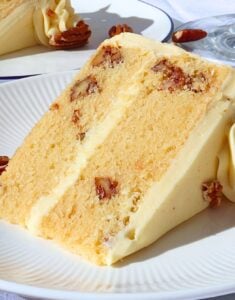
When I say this recipe took me MONTHS to perfect, I honestly mean it! This vanilla cake has the most soft, tender, melt-in-your mouth crumb and is bursting with vanilla flavour. A moist vanilla cake that acts as a great base recipe that can be paired with literally any type of frosting and filling!

What makes this vanilla cake so soft and moist?
Well, there’s a few different things at play here! I’ll explain them all briefly below.
Ingredients
When developing this recipe, I took great care in experimenting with different ingredients, and adjusting their quantities as needed to achieve the perfect texture and flavor.
The first notable ingredient is cornstarch. This recipe uses a cake flour substitute, which is a mixture of all purpose flour and cornstarch. This is because cake flour is banned here in New Zealand, which is why I can’t just use regular cake flour (to read more about this, check out my cake flour substitute blog post). Cake flour has a lower protein content than regular flour, which results in a more tender crumb. By substituting some of the flour with cornstarch, you get a similar result to cake flour as cornstarch doesn’t have any gluten, therefore reducing the overall protein content.
Secondly, this recipe uses oil, vinegar and buttermilk to really amp up the softness! Oil is liquid at room temperature, resulting in a moist cake. Vinegar and buttermilk help to break down the protein in the flour, resulting in a fluffier cake. This is due to the acid in both vinegar and buttermilk. For more on the magic of vinegar in baking, click here.
Mixing Method
Another factor is the mixing method.
Firstly, this recipe relies on the creaming method. The creaming method is a technique used in baking to incorporate air into a mixture, typically when making cakes and cookies. This method is crucial for achieving certain desired characteristics in the final baked product, such as the light and fluffy texture of this vanilla cake.
What creaming does is it introduces air into the mixture, creating small air pockets. During baking, these air pockets expand due to the leavening agents (like baking powder or baking soda), leading to a light and fluffy texture.
Another notable step in the mixing method, is the hand mixing at the end of preparing the cake batter. This recipe uses an electric mixer at first, but when it comes to folding in the dry ingredients at the end, you want to use your hands. By being ‘gentle’ with the flour, you’re going to prevent too much gluten from forming, which is great for things like bread, but we don’t want TOO MUCH gluten in a cake!
Why it took me months to come up with this recipe
I’ve tried so many vanilla cake recipes, and even have an old recipe of my own on YouTube! Many of you love that original recipe, but many were also struggling with the initial creaming process because of the high oil content.
When I launched my new blog, my goal was to create simple recipes that people could easily recreate. Because many people were struggling with my first vanilla cake recipe, I was determined to come up with another recipe that was simpler, and less dense.
Trialling the Reverse Creaming Method
Now for some reason I became OBSESSED with the reverse creaming method. This is where you first beat the butter with the dry ingredients and sugar, coating the dry ingredients with a layer of fat which prevents gluten formation. You then mix the remaining wet ingredients into the flour.
I read so much about the reverse creaming method and was determined that it would be the new method I use to make my vanilla cake. I PROBABLY MADE 30 CAKES over the span of a few months trying to get that perfect texture, but I just couldn’t get it right. I think the problem was that I was using a cake flour substitute instead of actual cake flour (cake flour is banned here in New Zealand so I use a flour and cornstarch mix instead). I tried with just regular flour too but my cakes kept coming out a little dense. When I would reduce the fat content, then the cakes would dry out really quickly. I FINALLY GAVE UP.
Sometimes when you know something works, you don’t need to try and be fancy or different to recreate something similar. I decided to go back to the original mixing method I used for my first vanilla cake, but instead of using my mixer to mix in the dry ingredients, I decided to hand mix the dry ingredients at the end. This method combined with different ingredient combinations finally led me to this cake – THE BEST VANILLA CAKE RECIPE I’VE EVER TRIED! 😀
How to make this vanilla cake
This recipe comes together relatively easily, but does require some careful steps. Follow them exactly and you’ll be on your way to success!
Start off by preheating your oven to 165°C/330°F with the fan on (if your oven doesn’t have a fan option, then you will need to increase the baking temperature to 175°C (350°F), and grease and/or lining two 8 inch cake pans. I like to grease my cake tins with my homemade cake release. I find this works well without having to use parchment paper to line my pans.
For the cake batter, start off by sifting together your dry ingredients. By premixing our dry ingredients, it helps ensure that everything is mixed well, preventing us from overmixing our batter when we come to combining our wet and dry ingredients.

Set your dry ingredients aside and in another bowl cream together your butter, oil and sugar for 2 minutes. This is going to incorporate air into our batter which will give us a fluffier cake!

Next add in your eggs one by one, mixing well in between each addition. Eggs add structure and moisture to our cake.
Next add in vanilla extract or essence, white vinegar and half a cup of buttermilk, and mix until well combined.

Now the last step is to fold in our dry ingredients while alternating with our buttermilk. So to do this, add in half of your dry ingredients and fold it into the wet mixture until just combined. Then add in your buttermilk, and fold that through until just combined. Lastly, add in your remaining dry ingredients and fold through until just combined.
It’s important to do this step by hand as this will prevent us from overmixing our batter and developing too much gluten. Gluten is what gives bread great structure, and although we want SOME structure for cakes, we don’t want too much otherwise it’ll make our cake tough and dense.


Once the batter is done, evenly distribute it into the two 8 inch cake tins and cook for 30 minutes, or until a toothpick comes out clean. Allow the cakes to completely cool before frosting.

How to make easy vanilla buttercream
This vanilla buttercream is literally the easiest thing ever! It is an American buttercream so is a ‘sweeter’ frosting, although my recipe does use a lot less icing sugar compared to a regular American buttercream. However, if you still want a less sweet frosting, I’d recommend a Swiss meringue or French buttercream.
So to make this easy buttercream, begin by adding your butter, icing sugar, vanilla and milk to the bowl of a stand mixer. Using the paddle attachment, mix on a low speed for about a minute until the ingredients are combined (this will prevent the icing sugar from flying everywhere!).

Once combined, turn up the speed to a medium-high and mix for a full 10 minutes. This is going to lighten up the buttercream in both taste and texture. It also helps to reduce the grittiness that you normally get with a traditional American buttercream. For a completely grit-free alternative, try out my grit-free American buttercream!

And that is it! You’re left with a beautifully smooth buttercream.
How to decorate this vanilla cake
You can go ahead and decorate this cake however you like, but here’s a little ‘how-to’ on how I did mine.
So to start off I trimmed off the brown bits around my cake layers, which in all honesty is not necessary at all – I just wanted the perfect thumbnail (haha!). You can skip this step if you want 🙂
I then went ahead and placed my first cake layer in the middle of a cake stand and smoothed out some buttercream on the top with my offset spatula.

I then placed the next cake layer on top, and again smoothed out some frosting on top of that layer with my offset spatula. I then used any excess frosting from the sides and top to cover the entire cake in a thin layer of frosting. This is what we call a crumb coat.
A crumb coat traps in all the crumbs, and is then chilled, before we place our final layer of frosting on.

Once the crumb coat is chilled, I then placed a generous amount of frosting all around the cake. I used my offset spatula to smooth out the top, and then a cake scraper to smooth out the sides.

Now when you scrape the sides of a cake, you usually end up with a lip of frosting around the top edges. To get rid of these and get a ‘sharp edge’ on the top, slowly bring your offset spatula into the middle of the cake, catching that lip of frosting as you go.
I then finished off by piping some little swirls on the top using a 1M piping tip.

And that is it! This vanilla cake is ready to serve 🙂
Commonly asked questions
How do you store vanilla cake?
This cake can be left at room temperature for a few days, but after that it’s best to refrigerate. When placing the cake in the fridge, be sure to place it in an airtight container to prevent the cake from drying out.
Can I freeze this vanilla cake?
I haven’t tried freezing this cake myself, but I have recieved feedback from others who have frozen this cake with success. The key to freezing cakes is making sure they’re wrapped really well in plastic wrap, with an additional layer of foil, and then placed into an airtight container before being placed in the freezer. This will help prevent freezer burn.
Can I use this cake for wedding cakes or birthday cakes?
You can absolutely use this cake for both birthday and wedding cakes. The only thing I will say is that the cake layers are very soft, so up to 3 layers it will be just fine (when using a good stable frosting), but I would recommend adding in additional supports if making a cake that is 4 layers or higher – just for extra security!
Can I make vanilla cupcakes with this recipe?
I haven’t tried this recipe as cupcakes yet, but I have recieved great feedback from others who have. Just be sure to reduce the cooking time when making cupcakes.

Soft Vanilla Cake
Print Pin VideoIMPORTANT: For accuracy, I would recommend using the gram measurements provided, as those are the exact quantities I use. Cup measurements are given as estimates (based on US cup measurements) to make it easier for those who do not have a scale.
Ingredients
Vanilla Cake
- 2¼ cups (300 g) flour - regular all purpose (see note 1 if you want to use cake flour)
- ¼ cup (25 g) cornstarch
- ½ tsp baking soda
- 1 tsp baking powder
- ½ tsp salt - omit if using salted butter
- ½ cup (113 g) unsalted butter - room temperature
- ½ cup (105 g) unflavoured vegetable oil - I use canola
- 1⅔ cups (332 g) white granulated sugar
- 3 large eggs - room temperature
- 1¼ tbsp vanilla essence/extract
- 1 tsp white vinegar
- 1½ cups (337 g) buttermilk - room temperature, see note 6 if using a homemade buttermilk substitute
Vanilla Buttercream Frosting (see note 4)
- 1½ cups (340 g) unsalted butter - room temperature
- 3 cups (375 g) powdered sugar - also known as icing/confectioners' sugar
- 1½ tsp vanilla essence/extract
- 1½ tbsp milk - heavy or whipping cream okay too
Instructions
- IMPORTANT: For this recipe I would highly recommend using gram measurements, especially for the flour for accurate results. It has a high fat/liquid ratio so slight adjustments to the quantities can throw off the balance of the cake 🙂
Vanilla Cake
- Preheat oven to 165 °C (330°F) with the fan on (see note 5 if you don't have a fan function) and grease and/or line two 8 inch cake tins (I use my homemade cake release).
- In a bowl, sift together your flour, cornflour, baking soda, baking powder and salt. Using a whisk or fork, mix until well combined. Set aside.
- In another bowl, add in your butter, vegetable oil and sugar. Using an electric mixer (hand or stand mixer are both fine - see note 2), cream together for 2 minutes until light and creamy.
- Add in eggs one by one, mixing well in between each addition (about 10-15 seconds between eggs).
- Add in your vanilla, vinegar and half a cup of the buttermilk, and mix until well combined. Now set your mixer aside as the remainder of the batter will be finished by hand.
- Finish off by adding in half of your premixed dry ingredients to your wet mixture, and gently fold it in with a spatula until just combined. Then add in the remaining 1 cup of buttermilk, and fold it in until just combined. Lastly, add in the remaining dry ingredients and gently fold it into the mixture until just combined. Do not overmix (see note 3).
- Distribute the batter evenly into the two 8 inch cake tins, and bake for 30 minutes or until a toothpick comes out clean.
- Once baked, allow the cake layers to cool in the cake tins for about 15-20 minutes, and then turn them out onto a wire rack to completely cool before frosting with the vanilla buttercream recipe below, or another frosting of your choice.
Vanilla Buttercream Frosting (see note 4)
- In the bowl of a stand mixer, add in the icing sugar, butter, vanilla and milk.
- Using the paddle attachment, mix on the lowest speed until the ingredients are combined (about a minute), and then turn up the speed to a medium high and mix for a full 10 minutes. Scrape the bowl down half way through.
- The frosting is now ready to use.
Video
Notes
Nutrition
Nutritional information are estimates only as they are automatically calculated by a third party application. Actual values may differ based on brands and types of products used.











1154 Comments
Hi MK: Love uour videos and how you present your cintent. Plain and to the point. I also love your vanilla cake recipe. It is to die for. I made one for my nephews birthday with a little tweeking and it came out great. I used orange juice instead of buttermilk (i dont have great experiences with buttermilk, dont know why but i think i will try again with thes recipe) and tried the tiger stripe technique with it. It was still good. I couldnt wait to get back home to thank you for such a moist, tender and delicious cake❤. Keep up the good work and best wishes.
Hi Shornaiter! 🙂 So so happy to hear you enjoyed the recipe and the addition of orange juice with the tiger stripe technique sounds amazing! Thanks so much for all your love and support 🙂
I cannot believe how good this cake is. The texture was perfect, and I am now a fan of (your) home made vanilla cake. Not something I usually enjoy. I rarely bake these days, however, with the cost of things these days, thought that making our birthday cakes should be the way to go in future. However, instead of me making the cake for my granddaughter, my 38 year old daughter (who never bakes) insisted on making it. So, with some supervision, she did a great job!! Also, I really don’t like butter cream. I can’t say that anymore 🙂 I have a few more birthdays coming up, so I’ll be checking out more of your recipes. Thank you
So so happy to hear you enjoyed the recipe Coral 😀 and so pleased to hear that the recipe was simple enough for your daughter to make it – sounds like you both did a marvelous job 😀
When I tell you this cake is our new family obsession I’m not joking. I already made this cake three times now and each time it comes out perfect if not better! It’s so moist and delicious we can literally eat it by itself with no icing or anything that’s how good it is. The last two times I doubled the recipe and we had amazing moist cake for a week in the fridge and it didn’t get dry or lost it’s tastiness. I recommend this cake to everyone now and if you’re hesitant about it you should totally make it with no worries and the ingredients are not that complicated! You could make it with different toppings not only frosting! I made it with some strawberry goo on the side and it became the perfect afternoon tea cake. I’m so excited to try all the other cake recipes with my family!!
My comment is turning into an essay at this point lol but this cake deserves all the hype🤌
Thank you so much for the wonderful feedback Danya! So so happy to hear you and your family are loving the recipe 😀 and strawberry goo on the side sounds so good! I’ll have to try that combo sometime soon 😀
Your cakes are amazing always use ur recipes 🥰🥰🥰
Thank you so much Hiwot! So happy to hear you’re enjoying the recipes 🙂
Do I have to distribute into two baking pans or can i cook it all in one and cut in half? How long would that take?
Also, what would it look like for a 10in pan and a 6in pan?
Hi Jamie! For this recipe you would need to use two baking tins, or one 10 inch pan will be okay :). If you want to use 6 inch tins, then you can half the recipe and then distribute it into two 6 inch cake tins. Hope that helps!
Would the baking time be the same?
Yes roughly about the same for anything larger than an 8 inch cake tin (assuming the thickness of the cake layers are about the same as when baking in an 8 inch cake tin), and for a 6 inch tin check the cake layers about 5 mins earlier than the stated cooking time 🙂
Can you easily use this recipe for cupcakes ? If so, what temperature would you recommend to bake and for how long?
Hi Lisa! I haven’t used this recipe as cupcakes before so I’m not too sure sorry! I do have another vanilla cupcake recipe if you wanted to try that out. Here is the link: https://cakesbymk.com/recipe/soft-vanilla-cupcakes/
Hi! I did this recipe in cupcakes – it yielded 24 cupcakes, and they turned out great!! Thank you!
Awesome! I’ve never tried this recipe as cupcakes so I’m so glad to hear it worked out well 😀
I made maaany many vanilla cakes and Hands down this is My absolute Favorite 💕💕 thank you so much i made it many times by now my Family LOVES it ❤️❤️ thank u for keeping it easy to flow as well
Hi Mema! So so happy to hear this recipe has made it to the top of your list! I am honoured 😀 and so happy to hear your family loved it too 🙂
Hi Maryam.
I would like to know whether I could use salted butter instead of unsalted for the American buttercream frosting??
Hi Fathima! 🙂 You can, however your frosting will have a slightly sharper taste to it. It will still be great though just depends on how strong you want your frosting to be 🙂
I would like to say thank you for sharing this recipe. It is the best I have tried. It was so moist, not toi sweet and melts in the mouth. This is now my go to vanilla cake recipe. ☺️
I’ve actually tried it with cake flour and it turned out good. I just had a hard time mixing the dry ingredients. It had so many lumps so I had to take the whisk and mix it for a little bit.
I just have a few questions because I am going to use this for my in-law’s bday cake this weekend.. Can I do reverse creaming method with cake flour? Is it not going to affect the final result? Which flour do you prefer to use for this recipe assuming cake flour is not banned in New Zealand, cake flour or all purpose flour? Does using cake flour or all purpose flour produces the same sponge?
Hi Zai! 🙂 So so happy to hear you enjoyed the recipe 😀 and yes you can gently mix it with a whisk if you’re struggling with the lumps :). I haven’t tried this recipe with the reverse creaming method, but if you’re using cake four then it may work well! We don’t have cake flour here in New Zealand hence I use a cake flour substitute which is a combination of all purpose flour and cornstarch. I wouldn’t recommend using this substitute for the reverse creaming method though, so definitely use cake flour if you want to give that method a try 🙂
You are BRILLIANT! The instruction is excellent, the cake is delicious,, most importantly, so moist! Well done.
Thank you for sharing with the world!
Thanks so much Brian! So happy to hear you’re enjoying the content, and enjoyed the recipe! 🙂