

This better than bakery sponge cake recipe is light, airy, and just straight up DELICIOUS! It’s so versatile that you can pair it with literally anything. I love filling mine like a classic Victorian sponge cake with my homemade raspberry filling recipe and whipped cream – YUM!

What is a Sponge Cake?
A sponge cake is a light and airy cake that is made primarily from whipped egg whites. Unlike other types of cake, such as butter or oil cakes, sponge cakes do not contain much fat which contributes to it’s light texture.
Sponge cake is often used as a base for other desserts, such as layered cakes, trifle, or as a component in various French-style pastries. It can also be served on its own, dusted with powdered sugar or paired with fresh fruit and whipped cream like a Victorian sponge cake (which is how I love mine!).
What makes this recipe stand out?
I am so proud of my sponge cake recipe and it is no doubt my favourite sponge I’ve tried, with the simple reason being – I don’t use that much flour!
Some flour is needed to help with the structure of the cake, however many recipes I’ve tried I feel use way too much and just end up being too heavy (almost like a regular cake). What I’ve done instead is substituted a lot of the flour with cornstarch, which helps thicken the batter without forming more gluten than we need. This results in the softest, airiest, bakery like sponge cake!
How to make Sponge Cake
Now I’m not going to sugar coat it, sponge cakes are a little more challenging to master than regular cakes! BUT, if you carefully follow the steps below you should end up with the perfect sponge 🙂
Begin by preheating your oven to 160 °C (320°F) with the fan on (see note 2 on recipe card if you don’t have a fan function) and line the bottom of two 8×3 inch baking tins with baking paper without greasing the bottom. Leave the sides of the cake tins ungreased and bare (do not line with baking paper). This will prevent the cakes from shrinking once they’re baked.

In a bowl combine your flour, cornstarch, baking powder and salt. Mix until well combined (you do not need to sift it yet). Set aside.
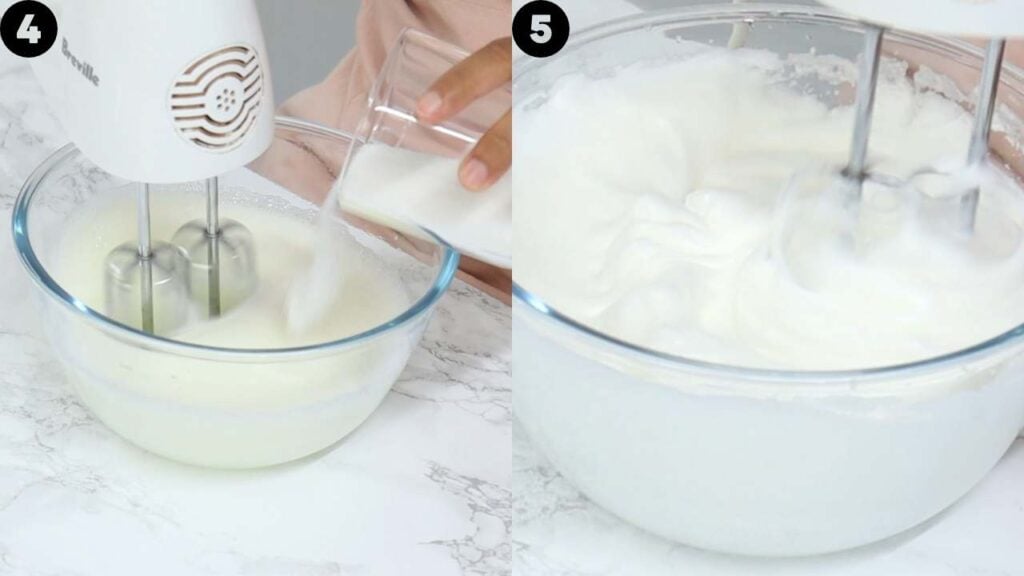
In a medium sized bowl add in the egg whites and white vinegar, and using a hand or stand mixer, whip on a medium high speed for 30 seconds until foamy. Gradually add in 1/3 cup of the sugar and then continue mixing for a further 2 minutes. Then turn your mixer down to low and mix for a further minute (about 4 minutes of mixing altogether). You should end up with stiff peaks (see note 3 on recipe card). Set aside.

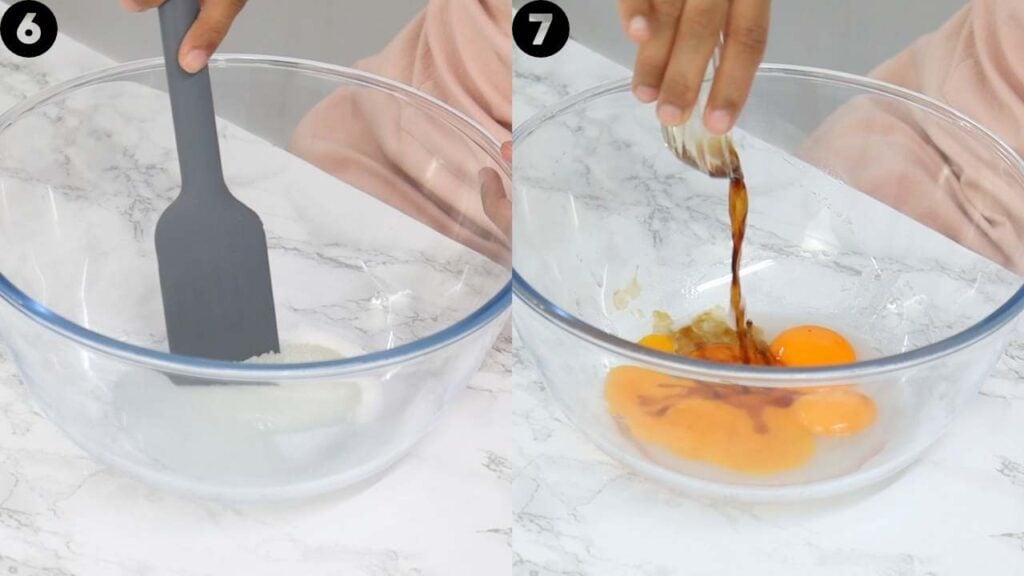
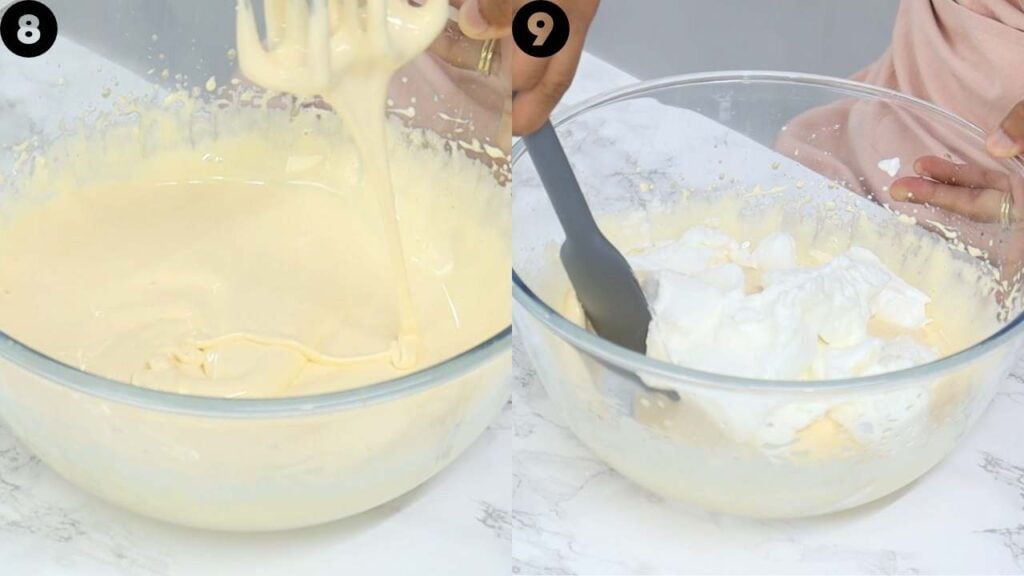
In a large bowl add in your remaining 1/3 cup of white sugar and warm water. Mix so that the sugar is coated in the water. Add in the egg yolks and vanilla, and with a hand or stand mixer, whip on a medium high speed for 4 minutes, and then turn the mixer down to low and mix for a further minute (5 minutes of mixing altogether). Your mixture should now be thick and you should be able to create ribbons with it when you lift it up with a spoon.
Stream the vegetable oil into the egg yolk mixture while mixing on a medium speed. Mix until well combined.
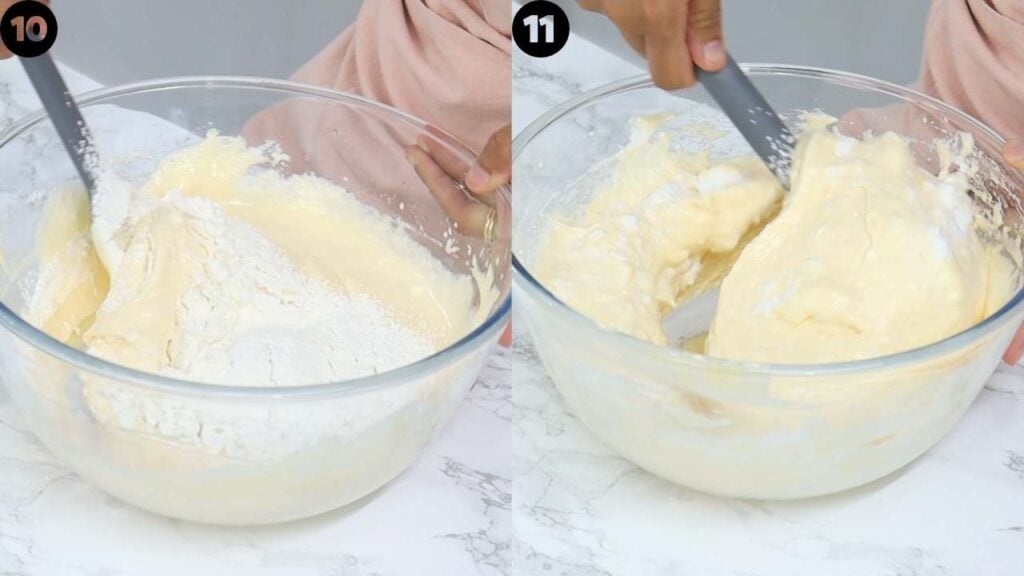
Add in half or your egg whites to your egg yolk mixture, and using a spatula gently fold together until just combined. Then sift in your dry ingredients, and gently fold through until just combined.
Finish off by adding in the remaining egg whites and gently fold until just combined. You can use your spatula to break up any large chunks of unmixed egg whites but try not to push out too many of the air bubbles and do not overmix.
Distribute the batter into your baking tins and then tap your baking tins lightly on your counter. Then run a thin knife or toothpick through the batter to remove any large air bubbles and then bake for 25 minutes. To test whether they’re done, gently touch the tops and it should create a little indent which slowly bounces back.

Once the sponges are done, immediately tap them on the counter from a height of about 10cm, and lay them upside down (while still in their baking tins) on a wire rack to completely cool (see note 4 on recipe card).

Once cooled (about an hour later), run a thin knife around the edges to release the cakes from the cake tins, and then turn them out onto a wire rack.
To make my cake layers look nice and neat, I gently rub my fingers around the edges and the top and that removes the dark crust on the sides and tops of the cake (see video for demonstration).

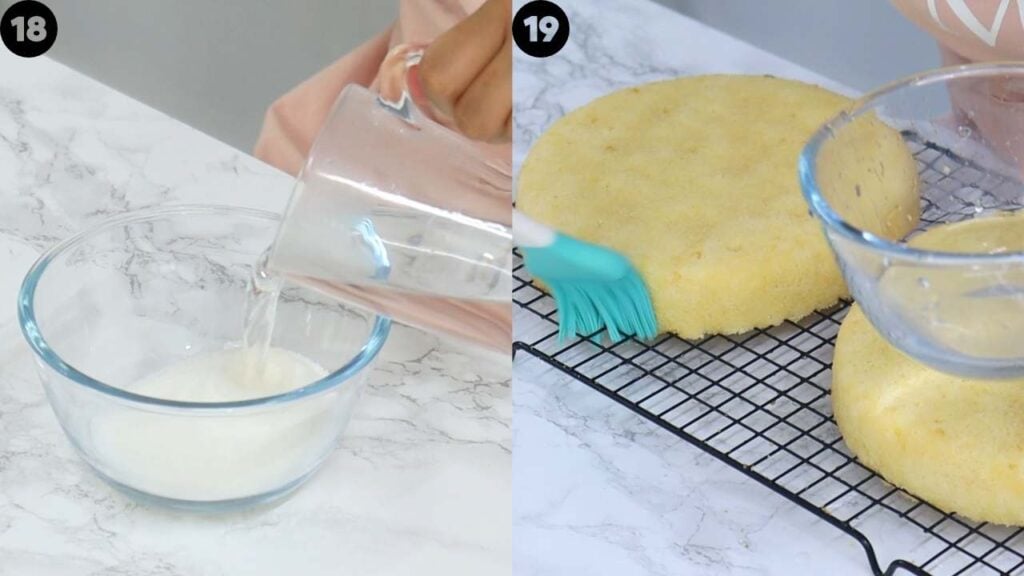
APPLY SIMPLE SYRUP: Combine sugar and hot water together for the simple syrup and mix until the sugar is completely dissolved. Using a pastry brush, generously brush the top and sides of the sponges with the simple syrup (see note 5 on recipe card).
How to Decorate a Sponge Cake
You can decorate your sponge cake however you like 🙂 but I like to fill mine with raspberry filling, strawberries and cream – YUM!
Place one sponge cake layer down, and cover the top with a thin layer of my raspberry jam filling.
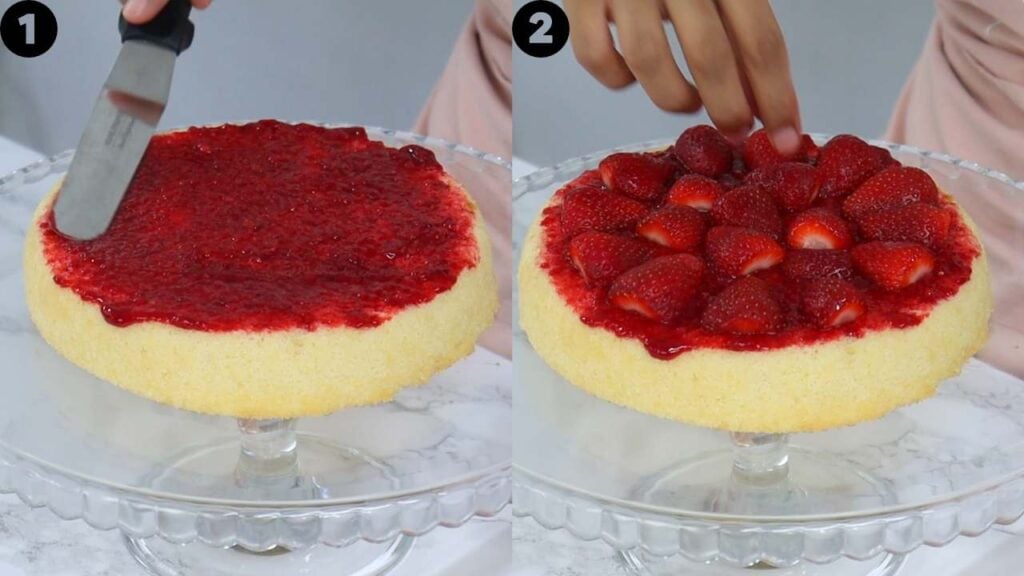
Place strawberries on top (I like to cut mine in half and place them upside down). Cover with generous amount of whipped cream and spread it out evenly with an offset spatula or knife.
Place your next sponge cake layer on top and then cover with more whipped cream. Finish decorating with more strawberries on top. Enjoy!


Light & Airy Sponge Cake Recipe
Print Pin VideoIMPORTANT: For accuracy, I would recommend using the gram measurements provided, as those are the exact quantities I use. Cup measurements are given as estimates (based on US cup measurements) to make it easier for those who do not have a scale.
Ingredients
Sponge Cake
- ⅓ cup (40 g) flour - regular, all purpose (see note 1)
- ½ cup (60 g) cornstarch
- ¼ tsp baking powder
- ¼ tsp salt
- 4 large eggs - whites and yolks separated, room temperature
- ⅛ tsp white vinegar
- ⅔ cup (132 g) white granulated sugar - separated in half - ⅓ cup (66g) for the egg whites & ⅓ cup (66g) for the egg yolk mixture.
- 1½ tbsp warm water - not boiling
- 2 tsp vanilla essence/extract
- 2 tbsp (30 g) unflavoured vegetable oil - I use canola
Simple Syrup
- ½ cup (100 g) white granulated sugar
- ½ cup (110 g) boiling water
Whipping Cream
- 2 cups (375 g) cold whipping cream
- 2 tsp icing sugar - also known as confectioners sugar/powdered sugar
- ½ tsp vanilla essence/extract
- 1 punnet fresh strawberries for decorating
Raspberry Jam
Instructions
Sponge Cake
- Preheat oven to 160 °C (320°F) with the fan on (see note 2 if you don't have a fan function) and line the bottom of two 8x3 inch baking tins with baking paper without greasing the bottom. Leave the sides of the cake tins ungreased and bare (do not line with baking paper).
- In a bowl combine your flour, cornstarch, baking powder and salt. Mix until well combined (you do not need to sift it yet). Set aside.
- In a medium sized bowl add in the egg whites and white vinegar, and using a hand or stand mixer, whip on a medium high speed for 30 seconds until foamy. Gradually add in 1/3 cup of the sugar and then continue mixing for a further 2 minutes. Then turn your mixer down to low and mix for a further minute (about 4 minutes of mixing altogether). You should end up with stiff peaks (see note 3). Set aside.
- In a large bowl add in your remaining 1/3 cup of white sugar and warm water. Mix so that the sugar is coated in the water. Add in the egg yolks and vanilla, and with a hand or stand mixer, whip on a medium high speed for 4 minutes, and then turn the mixer down to low and mix for a further minute (5 minutes of mixing altogether). Your mixture should now be thick and you should be able to create ribbons with it when you lift it up with a spoon.
- Stream the vegetable oil into the egg yolk mixture while mixing on a medium speed. Mix until well combined.
- Add in half of your egg whites to your egg yolk mixture, and using a spatula gently fold together until just combined.
- Then sift in your dry ingredients, and gently fold through until just combined.
- Finish off by adding in the remaining egg whites and gently fold until just combined. You can use your spatula to break up any large chunks of unmixed egg whites but try not to push out too many of the air bubbles and do not overmix.
- Distribute the batter into your baking tins and then tap your baking tins lightly on your counter. Then run a thin knife or toothpick through the batter to remove any large air bubbles and then bake for 25 minutes. To test whether they're done, gently touch the tops and it should create a little indent which slowly bounces back.
- Once the sponges are done, immediately tap them on the counter from a height of about 10cm, and lay them upside down (while still in their baking tins) on a wire rack to completely cool (see note 4).
- Once cooled (about an hour later), run a thin knife around the edges to release the cakes from the cake tins, and then turn them out onto a wire rack.
- To make my cake layers look nice and neat, I gently rub my fingers around the edges and the top and that removes the dark crust on the sides and tops of the cake (see video for demonstration). I find the dark crust on sponge cakes are also what contain that slight eggy after taste sometimes, which is why I prefer to remove it.
- APPLY SIMPLE SYRUP: Combine the sugar and hot water together for the simple syrup and mix until the sugar is completely dissolved. Using a pastry brush, generously brush the top and sides of the sponges with the simple syrup (see note 5). I use about 3/4s of the simple syrup mixture in total.
Whipped Cream
- In a large bowl add in the whipped cream, icing sugar and vanilla. Whip until you reach stiff peaks. Be careful not to overwhip the cream.
Assembly
- Place one sponge cake layer down, and cover the top with a thin layer of my raspberry jam filling.
- Place strawberries on top (I like to cut mine in half and place them upside down). Cover with generous amount of whipped cream and spread it out evenly with an offset spatula or knife.
- Place your next sponge cake layer on top and then cover with more whipped cream. Finish decorating with more strawberries on top. Enjoy!
Video
Notes
Nutrition
Nutritional information are estimates only as they are automatically calculated by a third party application. Actual values may differ based on brands and types of products used.











649 Comments
Can I substitute the all purpose flour for a 1-1 all purpose gluten free flour?
Hi Loni! 🙂
Hmm good question! Usually sponge cakes are a bit temperamental, but because this recipe doesn’t use too much flour, I think it would work okay! Would love to hear how it goes if you decide to try it out 🙂
This is awesome. If I want to double the recipe, what size cake pans should I use and how long should I bake.
Thanks so much Nisha! 😀
If doubling the recipe, you’d want to either use four 8 inch cake tins, or two 10 inch cake tins. Bake time should roughly be the same (might be a little longer for the 10 inch cakes) 🙂
First time I made it and I’m so delighted with the result. It’s sooo spongy and airy. Although I reduced the sugar a little bit, doubled the recipe and used 13×9 baking pan. It turns out really well. However, is it normal that it deflates a bit afterwards?
Yay! So so happy to hear you loved the recipe 😀
Deflating a little bit is normal, but it shouldn’t deflate a lot (cooling them upside down helps with this) 🙂
Wow, I have found my to go recipe from now on. Tried it and it is superb. Thank you soo much for the recipe the notes and videos.
Yay! Thank you so much for the wonderful feedback Samantha 😀
So so happy to hear you loved the sponge cake 🙂
Love it 😍
Thanks so much Salma! 😀
Hi’ I’d love to try your recipe for my daughter’s birthday cake. Do you think it would hold under fondant if I added on top to cover the cake, for decorations?
Hi there! 🙂
Unfortunately this recipe is very soft and light, and will likely not hold well under fondant. Buttercream itself tends to weigh the sponges down, which is why whipped cream or light frostings are best used with this recipe – sorry about that!
For a soft and moist vanilla cake that will hold well under fondant, I would recommend checking out my vanilla cake recipe: https://cakesbymk.com/recipe/soft-vanilla-cake/
Hope that helps 🙂
I’m excited to try this recipe.
Can I freeze the sponges and if so should I brush with syrup before freezing or after thawing?
Hi Jeanne! So glad you’re wanting to give this recipe a go 😀
I think applying the simple syrup after thawing the cakes will be best as adding it before freezing could result in a mushy cake when thawing. Hope that helps and hope you enjoy the recipe 😀
This is my absolute favourite go to cake for soft and fluffy and light texture. I have baked this cake over 10 times and perfect every time 😍. Do you think I could swap the oil with thick greek yogurt? Thanks
This makes me so so happy to read K! 😀
I haven’t tried that myself so I’m not too sure how it would affect the sponge sorry! I find that oil in general helps to maintain the moisture of baked goods for longer, though yoghurt is great for moisture as well so may work okay too 🙂
Would love to hear how it goes if you decide to try it out 🙂
Excited to try this today! Can you make this in advance and freeze it??
Hi Mia! So glad you’re wanting to give this recipe a go 😀
I haven’t tried freezing these cake layers myself so I’m not too sure sorry! Usually if cakes are wrapped well in plastic wrap and placed into an airtight container before freezing they’re fine, so I would just make sure they’re stored well if you wanted to try freezing them 🙂
Would love to hear how it goes if you decide to try it out Mia 🙂
Best sponge cake ever. Just as described light and fluffy but also stays fresh longer than any other recipe I’ve tried. Thank you
Aww yay! So so happy to hear you loved the sponge cake Jennifer 😀