

Today we’re going to be talking about a question I get all the time, why do you use vinegar in some of your cakes?
I know… it may sound a little strange but vinegar is like a secret ingredient that adds a little extra magic to your cakes, and today we’re going to find out why!

Vinegar has been used for centuries in cooking and baking. Its magical properties lie in the acetic acid it contains and when added to baking, vinegar is a game-changer, enhancing flavors, textures, and even contributing to the rise of our baked goods.
Picture this: you’re preparing a cake, and you want it to be super fluffy and moist. Enter vinegar! So how exactly does its acidic nature help with this? Well there’s a few reasons!
Vinegar helps with the rise of our baked goods
Firstly, vinegar helps our baked goods rise and create an airy texture by reacting with baking soda. When vinegar reacts with baking soda, it creates carbon dioxide bubbles, which act as leavening agents.
So as the batter bakes, these tiny bubbles expand, causing the cake to rise and giving it that light, airy texture we all love.
Vinegar helps with creating a tender and moist crumb
But it’s not just about the rise! Vinegar also helps in creating a tender and moist crumb in our baked goods.
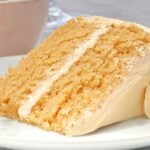
This is because the acidity of vinegar interferes with gluten development. Gluten is a protein that can make our baked goods tough when overworked, which is why you’ll often hear me talking about not overmixing your batter. By inhibiting gluten development, vinegar allows for a more delicate crumb and a soft, moist texture (e.g. my Oreo cake recipe pictured below uses a touch of vinegar to create a melt in your mouth crumb!).

And It’s not just cakes that benefit from a touch of vinegar, but also biscuits, muffins, and even bread.
So when it comes to bread, it’s the same concept – vinegar inhibits gluten formation which leads to a more relaxed and extensible dough, resulting in a less dense and chewy bread. On top of that, Vinegar can also enhance the browning of baked goods, and it also acts as a natural preservative, extending the shelf life of homemade bread. The acidic environment created by vinegar inhibits mold and bacteria growth, helping your bread stay fresh for longer.
Homemade buttermilk substitute
Here’s a fun fact: vinegar is often used to make homemade buttermilk by adding it to regular milk. This buttermilk substitute adds tanginess to baked goods and is perfect for recipes like pancakes and waffles. If you’re interested in learning how to make this buttermilk substitute, check out my blog post on how to make homemade buttermilk.
So there you go – the next time you bake, consider the magic of vinegar! Its ability to create lighter textures, tender crumbs, and improve browning is why people across the baking world embrace this simple yet powerful ingredient.













51 Comments
Could you use citric acid (powder) as a replacement?
Hi Natalia! So in theory yes it should work, but I haven’t tried it myself so can’t say for sure sorry 🙂
Thank you for all the recipes you sent, can vinegar or buttermilk be added to a chocolate cake and vanilla,and other cake recipes? And the measurement pls. Thank you
Hi Billy! Yes it can be 🙂 I use about 1/2 tsp per 1 cup of flour 🙂
Hi Maryam,
Would it be possible to put vinegar in cake mixes? And if so would the amount be the same?
Hi Fatima! I haven’t tried that myself so I’m not too sure how it would turn out sorry! If you do want to give it a go then I would stick to about 1/2 tsp per cup of flour 🙂
Hello..will adding vinegar also make almond flour or/and coconut flour cakes lighter?
Hi Marie! Great question – I haven’t tried that myself so I’m not too sure, but I believe adding vinegar to anything with gluten/protein in it would work so it may be worth a try! I’m honestly not too sure though but would love to hear how you go if you decide to try it out 🙂
If using vinegar does the recipe always have to have buttermilk in it? Also, when is it best to add the vinegar in the recipe?
Hi Lanie! 🙂 No you can use vinegar without having buttermilk in the recipe 🙂 and I would add vinegar if I like the taste of a recipe but it’s not as soft as I would like and see if the addition of vinegar helps. Sometimes adding both vinegar and baking soda in a recipe also helps if the recipe doesn’t having baking soda already. Hope that helps!
thank you for the information about putting vinegar in cakes and bread.What about bread 🍞 that you make in bread making machines. What kind of white vinegar can you use. Thank you in advance for any advice.
Hi Sandra! So happy to hear you enjoyed the post 🙂 and just regular white vinegar should work well for bread, about 1 tsp per cup of flour 🙂
thank you for getting back to me
well known fact, but shoukdnt there also be directions on how much to add? Tablespoon? Teaspoon? To how much flour or baking soda?
Hi Lynn! Ahh yes I didn’t think to add that in, was more caught up in answering the question as to why I use it haha. Thanks for bringing this up I’ll amend my post shortly 🙂 for your reference I usually use about 1/2 tsp of vinegar per 1 cup of flour for cakes 🙂
Hi Maryam,
How much would you use in bread?
I would be really interested in that for Scottish rolls I would like to make.
Keep up the good work.
Margaret.
Hi Margaret! So in cakes I use about 1/2 tsp per 1 cup of flour, but for bread you use a little more, about a teaspoon per cup of flour 🙂 hope it makes a difference!
Love your recipes and have made several of them. Your white cake is my go to now. Do you think vinegar can be added to other cake recipes to achieve the light fluffiness of your cakes? Is there some combination of ingredients in a recipe that would indicate it would be ok to add a bit of vinegar?
Hi Marilyn! So happy to hear you’re enjoying the recipes 😀 and yes vinegar can be added to other cake recipes too! I would stick with recipes that don’t already have a lot of acid in them. I usually use 1/2 tsp of vinegar per 1 cup of flour for reference 🙂
I loved your apple crumble but have lost the recipe. How can l find it please?
Hi Valerie! 🙂 I haven’t shared an apple crumble yet so perhaps you mean a different recipe? You can view all my recipes here: https://cakesbymk.com/all-recipes/
Hope that helps!
Thankyou, I use vinegar in my homemade buttermilk for my chocolate cake, I am unaware that I could add it to my bread mix too. Would you have the bread making recipe too, I’d like to try it out when next I am baking bread.
Hi Adeola! 🙂 Unfortunately I don’t have any bread recipes to share at this stage but I’ll keep that in mind for future recipes 🙂