

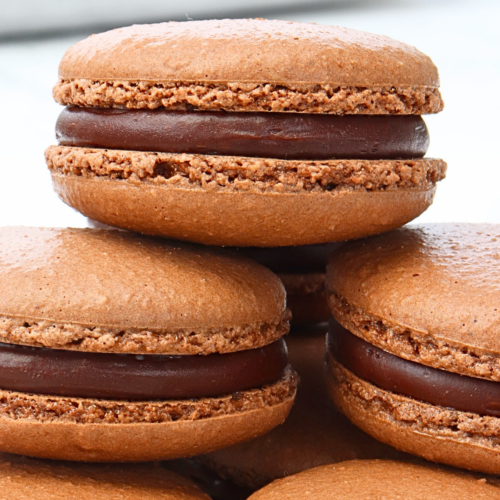
These luxurious, rich chocolate macarons boast beautifully crisp shells with a soft, chewy interior, all filled with a rich, decadent chocolate ganache that melts in your mouth. Macarons can be intimidating, and rightly so – there’s no denying they’re tricky to make. But don’t worry, this thoroughly tested French macaron recipe will guide you through the intricate steps of crafting perfect macarons right in your own kitchen!

My Top Tips for Making Chocolate Macarons
Making macarons can be tricky, but with a few key tips, you can improve your chances of success. Here are my top tips to help you avoid common mistakes:
1. Perfecting Meringue Consistency:
The consistency of your meringue is critical. Overbeating or underbeating the egg whites can lead to macarons that don’t rise properly or have a dense texture. Aim for a stiff, glossy meringue that holds its shape.
2. Refining Almond Flour Texture:
Ensure your almond flour is finely ground for a smooth batter. While store-bought almond flour usually works, I prefer processing it in a food processor before use. Coarse almond flour can cause lumpy or grainy macarons.
3. Mastering Macaronage Technique:
The macaronage, or folding process, is essential. Fold the almond flour and powdered sugar mixture into the meringue gently yet thoroughly. Overmixing or undermixing can result in flat macarons or hollow shells.
4. Managing Temperature and Humidity:
Macarons are sensitive to their environment. Temperature and humidity can greatly affect their consistency and appearance. Baking in humid conditions or at incorrect temperatures may lead to cracked, overly spread, or hollow macarons.
5. Understanding Oven Variability:
Every oven is different, and finding the perfect temperature and bake time may require some trial and error. Even small variations in oven temperature can make a big difference in the final result.
6. Allowing Proper Resting Time:
Resting the piped macaron shells before baking is crucial for developing their signature “feet” and smooth tops. Resting times can vary based on humidity and batter consistency. Typically, my macarons take about 45 minutes to form a skin, but it can take longer in more humid conditions.
Troubleshooting Macarons: Common Issues and Solutions
1. Meringue Won’t Reach Stiff Peaks
Issue: The meringue doesn’t whip to stiff peaks.
Solution: Ensure there’s no fat residue on your mixing bowl, spoons, or mixer attachments, as this can prevent the meringue from forming properly. Add sugar gradually, and whip at medium speed until stiff peaks form. In humid climates, stabilizing the meringue with a small amount of acid like cream of tartar, lemon juice, or vinegar can help achieve the desired consistency.
2. Macarons Have No ‘Feet’
Issue: Macarons come out flat without their signature ‘feet.’
Solution: Allow the macarons to dry and form a skin before baking. You should be able to lightly touch the surface without it sticking. This helps air escape from the bottom, forming the ‘feet.’ Also, ensure the meringue is properly whipped and the batter isn’t under or overmixed.
3. Flat or Spreading Macarons
Issue: The macarons spread too much and lose their shape.
Solution: Properly whip the meringue to stiff peaks and avoid overmixing the batter during macaronage. Ensure the oven temperature is accurate, and resist opening the oven door frequently during baking.
4. Cracked Macarons
Issue: Cracks or wrinkles appear on the surface.
Solution: Cracks can result from overmixing, uneven oven temperatures, or rapid temperature changes. Use gentle macaronage and let the piped shells rest until they develop a dry skin. Maintain consistent oven temperature and avoid opening the oven door too early.
5. Hollow Shells
Issue: Macarons have hollow pockets inside.
Solution: Hollow shells can be caused by overmixing, insufficient resting, or incorrect oven temperature. Mix gently, allow enough resting time, and ensure even baking by checking oven temperature and time.
6. Hard Shells
Issue: The macaron shells are too hard after baking.
Solution: Hard shells are usually due to overbaking. Check the macarons frequently towards the end of the baking time, and remove them as soon as the tops are firm but the feet don’t move. Use an oven thermometer to ensure the correct temperature.
7. Uneven Feet
Issue: The feet are uneven or lopsided.
Solution: Uneven feet may be caused by uneven piping or inconsistent oven heat. Use a piping template and tap the baking sheet to release air bubbles before baking.
8. Sticky or Moist Shells
Issue: The shells are sticky or too moist.
Solution: Underbaking or high humidity can cause sticky shells. Extend the baking time and ensure the macarons are fully cool before removing them. Consider baking on a dry day or using a dehumidifier.
9. Uneven Macaron Shells
Issue: Macarons have irregular shapes or sizes.
Solution: Use a piping template for uniform size and mix the batter evenly during macaronage. Tap the baking sheet to release air bubbles for smoother shells.
Remember, mastering macarons takes practice. It has taken me a LONG time to comfortable make macarons and I still get it wrong sometimes. With time and attention to detail, you’ll overcome these challenges and perfect your technique! 😊
Feel like more chocolate loaded recipes? Check out my chocolate sheet cake, hot chocolate recipe and chocolate muffins!
How to Make Chocolate Macarons
You can find the full list of ingredients for these chocolate macarons in the recipe card at the end of the blog post (for easy navigation, hit the ‘jump to recipe’ button at the top of the blog post). Here is a quick visual breakdown of the recipe (recipe video is also provided in the recipe card below).
Chocolate Macaron Shells
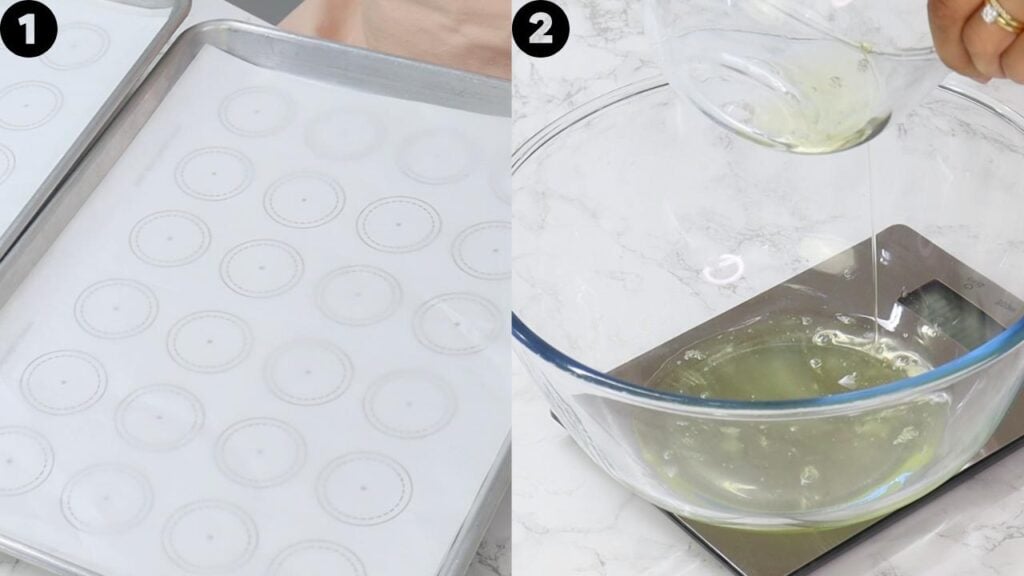
Begin by lining two large baking trays with parchment paper. Use trays that don’t have a high edge – a little lip on the edges is okay. I would recommend using macaron templates for piping the shells, especially if you are a beginner. You can download and print my 2-inch macaron template here (you will need 3 copies). Place the template under the parchment paper. Set the trays aside for now.
If using whole eggs, separate the whites from the yolks. Ensure you do not get any of the yolks into your whites. Weigh out the egg whites and then set them aside for now.
Place the almond flour, powdered sugar and cocoa powder into a food processor (this step is optional, but recommended). I like to use Dutch processed cocoa powder for chocolate macarons (results in a deeper chocolate color). Process for about 5 seconds, give the ingredients a mix and then process again for another 5 seconds. Do not overprocess it.
Once processed, transfer the dry ingredients to a sieve and sift. Once you get to the end, use your hands or a spoon to break any large lumps and gently push the remaining ingredients through the sieve. If there are any large bits remaining (this is usually just larger pieces of almond flour), discard them. If you discard a lot of it (more than half a teaspoon or so), add a bit more almond flour to the dry ingredients to make up for this. Set the dry ingredients aside for now.

Next is the meringue. Place your egg whites in a large bowl and add in the salt. Using a hand or stand mixer (use the whisk attachment if using a stand mixer) on a medium speed, whip for 30 seconds until the eggs become frothy. Once frothy, gradually add in the granulated sugar. Once all the sugar is added in, continue to whip until you reach stiff peaks (about 5-7 minutes). You should be able to lift up the meringue and the peaks shouldn’t fold over – they should stay upright (see video for demonstration).
Next add in vanilla. Mix into the meringue on a low speed until well combined. Set the mixer aside as the remainder of the mixing will be done by hand.

Next is the macaronage. Add half of the dry ingredients into the meringue, and using a spatula, gently fold in a ‘J’ motion, sweeping around the edge of the bowl and then cutting through the middle of the batter (see video for demonstration). Once the first half of the dry ingredients is almost mixed in, add in the remaining half. Continue to fold until combined.
Once combined, begin gently pushing the batter up against the sides of the bowl to remove large air bubbles. As you do this, the batter will become looser in consistency. You know the batter is ready when you can lift the batter up with the spatula and slowly create a figure 8 without the batter breaking. If the batter breaks before you can complete the figure 8, mix a little more. Another sign is checking if the batter forms ribbons and sinks into itself for about 10-15 seconds then stops. Keep checking the consistency of the batter frequently to ensure you aren’t overmixing it.

Once ready, transfer the macaron batter to a pastry bag with a 1A large round tip on it. Pipe the shells perpendicular to the trays to ensure they’re even. Because the batter will spread a little, pipe the shells slightly smaller than the size that you want. To prevent the parchment paper from moving while piping, place a spoon or fork on the edges to weigh the paper down.

Once all the shells are piped, carefully remove the templates (and anything used to weigh the parchment down) and tap the trays on the counter until the tops of the chocolate macarons are smooth with no tips in the middle. If there is still a tip in the middle even after tapping the tray numerous times, it means the batter is undermixed. Any large air bubbles should come to the top, which you can then pop with a toothpick or knife.
Allow the macaron shells to dry for 30 minutes to an hour, or until a skin forms on the top. You should be able to gently run your finger across the top of the shell without the batter breaking. If you live in a humid climate, it can take up to 2 hours for a skin to form. About 20 minutes into the shells drying, preheat your oven to 150C/300F.
Once a skin has formed, bake one tray at a time in the middle rack of your oven for 18-22 minutes. You know the macarons are ready when you gently touch/move the tops and the feet do not move. Check at the 18-minute mark, and if the macarons are not ready, check every minute after that as they can overbake very quickly.

Once baked, allow the shells to completely cool before gently peeling them away from the parchment paper. There should be little to no residue left behind.
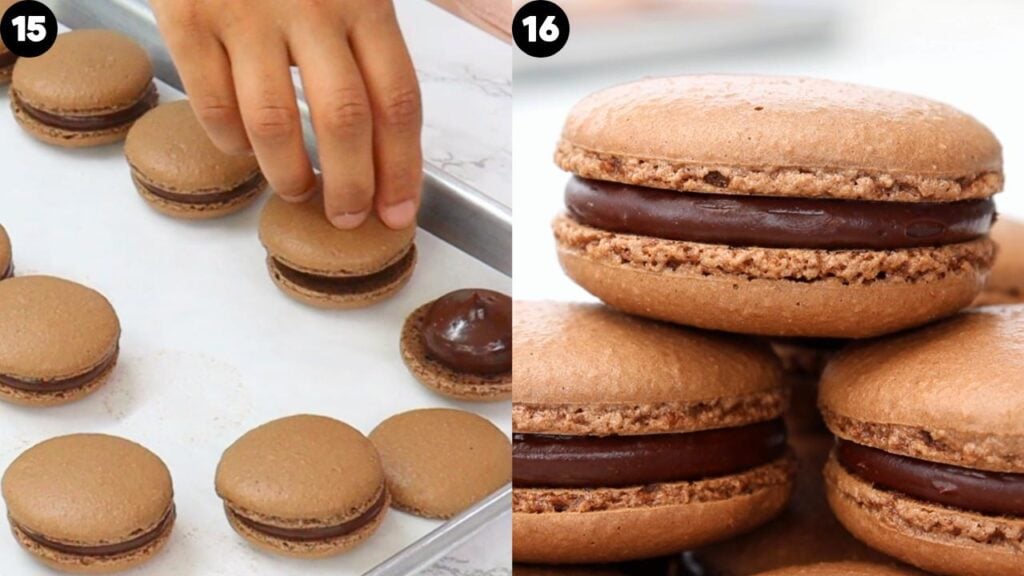
Pipe the chocolate ganache filling (recipe below) into the middle of a shell (I use a 1A piping tip to do this), leaving a little space around the edges. Place another shell on top and gently press down to push the filling to the edges of the macaron. Repeat this step with the remaining chocolate macarons.

Store in an airtight container in the fridge to mature for 24-48 hours. Once ready, allow them to come to room temperature to soften before serving.
Chocolate Macarons (Rich & Decadent!)
Print Pin VideoIMPORTANT: For accuracy, I would recommend using the gram measurements provided, as those are the exact quantities I use. Cup measurements are given as estimates (based on US cup measurements) to make it easier for those who do not have a scale.
Ingredients
Chocolate Macaron Shells
- 3 large (100 g) egg whites - room temperature
- 1½ cups (140 g) almond flour
- 1 cup (120 g) powdered sugar - also known as icing/confectioners sugar
- 2 tbsp (13 g) cocoa powder - I use Dutch-processed cocoa powder for a deeper color
- ¼ tsp salt
- ½ cup (100 g) white granulated sugar
- ½ tsp vanilla extract/essence
Chocolate Ganache
- 1 cup (170 g) dark or semi-sweet chocolate - I like to use 50% dark chocolate. Use a good quality block.
- ⅔ cup (150 g) heavy cream
- 1 tbsp unsalted butter
- ¼ tsp vanilla extract/essence
- pinch of salt
Instructions
- Before beginning, I would highly recommend weighing all the ingredients when making macarons using a digital kitchen scale. Precision is key to getting perfect macarons 🙂
Chocolate Macaron Shells
- Begin by lining two large baking trays with parchment paper. Use trays that don't have a high edge - a little lip on the edges is okay. I would recommend using macaron templates for piping the shells, especially if you are a beginner. You can download and print my 2-inch macaron template here (you will need 3 copies). Place the template under the parchment paper. Set the trays aside for now.
- If using whole eggs, separate the whites from the yolks. Ensure you do not get any of the yolks into your whites. Weigh out the egg whites and then set them aside for now.
- Place the almond flour, powdered sugar and cocoa powder into a food processor (this step is optional, but recommended - see note 1). Process for about 5 seconds, give the ingredients a mix and then process again for another 5 seconds. Do not overprocess it (see note 2).
- Once processed, transfer the dry ingredients to a sieve and sift. Once you get to the end, use your hands or a spoon to break any large lumps and gently push the remaining ingredients through the sieve. If there are any large bits remaining (this is usually just larger pieces of almond flour), discard it. If you discard a lot of it (more than half a teaspoon or so), add a bit more almond flour to the dry ingredients to make up for this. Set the dry ingredients aside for now.
- Next is the meringue. Place your egg whites in a large bowl and add in the salt. Using a hand or stand mixer (use the whisk attachment if using a stand mixer) on a medium speed, whip for 30 seconds until the eggs become frothy. Once frothy, gradually add in the granulated sugar. Once all the sugar is added in, continue to whip until you reach stiff peaks (about 5-7 minutes). You should be able to lift up the meringue and the peaks shouldn't fold over - they should stay upright (see video for demonstration).
- Next add in vanilla. Mix into the meringue on a low speed until well combined. Set the mixer aside as the remainder of the mixing will be done by hand.
- Next is the macaronage. Add half of the dry ingredients into the meringue, and using a spatula, gently fold in a 'J' motion, sweeping around the edge of the bowl and then cutting through the middle of the batter (see video for demonstration). Once the first half of the dry ingredients is almost mixed in, add in the remaining half. Continue to fold until combined.
- Once combined, begin gently pushing the batter up against the sides of the bowl to remove large air bubbles. As you do this, the batter will become looser in consistency. You know the batter is ready when you can lift the batter up with the spatula and slowly create a figure 8 without the batter breaking. If the batter breaks before you can complete the figure 8, mix a little more. Another sign is checking if the batter sinks into itself for about 10-15 seconds then stops. Keep checking the consistency of the batter frequently to ensure you aren't overmixing it.
- Once ready, transfer the batter to a piping bag with a 1A large round piping tip on it. Pipe the shells perpendicular to the trays to ensure they're even. Because the batter will spread a little, pipe the shells slightly smaller than the size that you want. To prevent the parchment paper from moving while piping, place a spoon or fork on the edges to weigh the paper down.
- Once all the shells are piped, carefully remove the templates (and anything used to weigh the parchment down) and tap the trays on the counter until the tops of the macarons are smooth with no tips in the middle. If there is still a tip in the middle even after tapping the tray numerous times, it means the batter is undermixed. Any large air bubbles should come to the top, which you can then pop with a toothpick or knife.
- Allow the macaron shells to dry for 30 minutes to an hour, or until a skin forms on the top. You should be able to gently run your finger across the top of the shell without the batter breaking. If you live in a humid climate, it can take up to 2 hours for a skin to form. About 20 minutes into the shells drying, preheat your oven to 150C/300F conventional (don't use convection mode/fan function - see note 3).
- Once a skin has formed, bake one tray at a time in the middle rack of your oven for 18-22 minutes. You know the macarons are ready when you gently touch/move the tops and the feet do not move. Check at the 18-minute mark, and if the macarons are not ready, check every minute after that as they can overbake very quickly.
- Once baked, allow the shells to completely cool before gently peeling them away from the parchment paper. There should be little to no residue left behind.
- Store in an airtight container in the fridge to mature for 24-48 hours. Once ready, allow them to come to room temperature to soften before serving.
Chocolate Ganache
- Roughly chop up dark chocolate and place into a deep jug or bowl. Set aside.
- Heat the cream over a stovetop until the edges begin to gently bubble. Keep a close eye on the cream to prevent it from overflowing or burning.
- Pour the heated cream over the chopped chocolate, along with the butter, vanilla, and salt, and let it sit undisturbed for 5 minutes.
- 5 minutes later, use an immersion blender (also known as a stick blender or hand blender) to blend the mixture until smooth and well combined. Pour it into a shallow dish for quicker cooling and cover it with cling wrap, ensuring the cling wrap touches the top of the ganache. This will prevent a skin from forming as it cools. Allow it to set and thicken for a few hours until it reaches a thick, pipeable consistency.
Video
Notes
Nutrition
Nutritional information are estimates only as they are automatically calculated by a third party application. Actual values may differ based on brands and types of products used.











2 Comments
These came out perfectly…great instructions
So so glad to hear that Ady! 😀