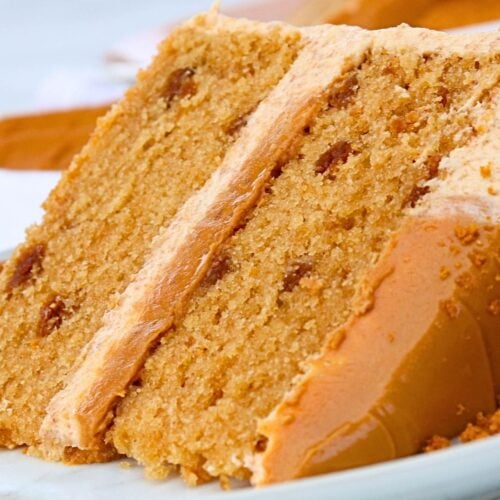
Moist Biscoff Cake (Cookie Butter Cake)
Print Pin VideoThis Lotus Biscoff cake (also known as a cookie butter cake) is made up of super moist, lightly spiced Biscoff cake layers, creamy (not-too-sweet) Biscoff buttercream and is filled with smooth Biscoff spread. It is so so good!
IMPORTANT: For accuracy, I would recommend using the gram measurements provided, as those are the exact quantities I use. Cup measurements are given as estimates (based on US cup measurements) to make it easier for those who do not have a scale.
Ingredients
Biscoff Cake
- 2⅓ cups (300 g) all purpose flour
- ¼ cup (30 g) cornstarch
- ½ tsp baking soda
- 2 tsp baking powder
- ½ tsp salt - omit if using salted butter
- 1 tsp ground cinnamon
- ½ cup (113 g) unsalted butter - room temperature
- ½ cup (105 g) unflavored vegetable oil - I use canola oil
- 1¼ cups (250 g) soft light brown sugar - firmly packed (see note 1)
- 3 large eggs - room temperature
- ½ cup (130 g) Biscoff spread (smooth) - also called cookie butter
- 2 tsps vanilla extract/essence
- 1¼ cups (280 g) buttermilk - room temperature
- 15 individual Biscoff cookies - plain cookies (not the ones with cream)
Biscoff Buttercream
- 15 individual Biscoff cookies - plain cookies (not the ones with cream). Blended to fine crumbs.
- 1½ cups (340 g) unsalted butter - room temperature
- 2¾ cups (350 g) powdered sugar - also known as icing/confectioners sugar
- 1½ tsps vanilla extract/essence
- ¼ tsp salt - omit if using salted butter (though I do not recommend using salted butter especially for frosting)
- 1½ tbsp milk or heavy cream
- ¼ cup (70 g) Biscoff spread (smooth) - also called cookie butter
Extra
- ⅔ cup Biscoff spread (smooth) - 1/3 for filling in between the cake layers and 1/3 for the top of the cake. Heat slightly to make the Biscoff spread more spreadable.
- Extra Biscoff cookies - for decorating (I use about 8 cookies, but you can use more or less).
Instructions
Biscoff Cake
- Preheat oven to 180°C (350°F) conventional (see note 2 if using a convection oven with a fan) and grease two 8 inch cake tins (I use my homemade cake release). I do recommend lining the bottoms of the pans as well for this recipe.
- In a bowl, sift together flour, cornstarch, baking soda, baking powder, salt and ground cinnamon. Using a whisk or fork, mix until well combined. Set aside.
- In a large bowl, add in butter, vegetable oil and light brown sugar. Using an electric mixer (hand or stand mixer are both fine - see note 3), cream together for 2 minutes until light and creamy.
- Add in eggs one by one, mixing well in between each addition (about 10-15 seconds between eggs).
- Add in Biscoff spread and vanilla and mix until well combined. Now set your mixer aside as the remainder of the batter will be finished by hand.
- Add in half of your premixed dry ingredients to your wet mixture, and gently fold it in with a spatula until just combined. Then add in the buttermilk and fold until just combined. Lastly, add in the remaining dry ingredients and gently fold until just combined. Do not overmix (see note 4).
- Break the Biscoff cookies into small chunks (I just use my hands) and add them to the batter. Fold them in until just combined. Do not overmix.
- Distribute the batter evenly into the two 8 inch cake tins. Level out the tops, drop the cake tins lightly on the counter to remove any large air bubbles and bake for 37-40 minutes or until a toothpick comes out clean or with a few moist crumbs on it.
- Once baked, allow the cake layers to cool in the cake tins for 20 minutes, then run a thin knife around the edges to release the cakes from the cake tins and turn them out onto a wire rack to completely cool.
Biscoff Buttercream Frosting
- In a food processor (or blender), place in the 15 Biscoff cookies and blend until they resemble fine crumbs. Set aside for now.
- To a large bowl (or stand mixer if using - see note 5), add in powdered sugar, butter, vanilla, salt and milk.
- Using an electric mixer, mix on the lowest speed until the ingredients are combined, and then turn up the speed to a medium-high and mix for a full 10 minutes. Scrape the bowl down half way through. Once done, the frosting should be light, fluffy and smooth (see note 6 if its not).
- Finish off by adding in the Biscoff spread and crumbed Biscoff cookies from earlier and mix on a medium speed until well combined.
Assembly (demonstrated in video)
- Begin by slightly heating the Biscoff spread so that its a more spreadable consistency. Set it aside to cool.
- Using a serrated knife, level out the tops of the cake layers. I also like to trim off the caramelised edges, however this is optional.
- Place the first cake layer onto your cake stand and place a generous amount of Biscoff buttercream on top and smooth it out with an offset spatula or knife.
- Using a 1M piping tip, pipe a dam of frosting around the edges of the cake layer. Fill the middle with half of the Biscoff spread (1/3 cup), but make sure the Biscoff spread isn't warm otherwise it will melt the buttercream.
- Place your next cake layer on top and cover the top and sides with more buttercream, leaving a little aside for piping on the top. I like to use a cake scraper to smooth out the sides.
- Use the same 1M piping tip to pipe a border around the top of the cake. Fill the middle with the remaining Biscoff spread (make sure it isn't warm) and decorate with Biscoff cookies. Enjoy!
Video
Notes
Note 1. If using measuring cups for this recipe, then you want to firmly pack your light brown sugar. To do this, pack your measuring cup with sugar and using the back of a spoon, press the sugar into the cup with a little bit of pressure (not too much) and then fill the remaining cup with more sugar.
Note 2. The fan forced (convection) function cooks cakes/cupcakes faster, so if baking on this mode then you will need to decrease the baking temperature to 160°C (320°F) so that the cake bakes at the same rate as mine 🙂
Note 3. If using a stand mixer, then use the paddle attachment for the initial mixing, but continue to do the last step by hand as stated in the recipe.
Note 4. By gently folding in the ingredients, it prevents too much gluten from forming, thus giving us a softer cake. Only mix until the strands of flour have disappeared and the batter is uniform.
Note 5. If using a stand mixer, use the paddle attachment.
Note 6. If your frosting is a bit firm, looks quite yellow and has heaps of air bubbles that won't go away after mixing the buttercream with a spatula, it means that your butter is a bit too cold. Heat the buttercream up slightly (5 second bursts in the microwave - do not overheat otherwise the buttercream will turn to liquid) until its softer in consistency and then re-whip. This should make it fluffy and very smooth.
Nutrition
Calories: 912kcal | Carbohydrates: 94g | Protein: 8g | Fat: 57g | Saturated Fat: 26g | Polyunsaturated Fat: 7g | Monounsaturated Fat: 11g | Trans Fat: 1g | Cholesterol: 136mg | Sodium: 324mg | Potassium: 128mg | Fiber: 1g | Sugar: 64g | Vitamin A: 1114IU | Vitamin C: 0.01mg | Calcium: 115mg | Iron: 2mg
Nutritional information are estimates only as they are automatically calculated by a third party application. Actual values may differ based on brands and types of products used.
Tried this recipe?I love hearing from you! Tag me @cakesbymk.nz on instagram so I can see your amazing creations :)