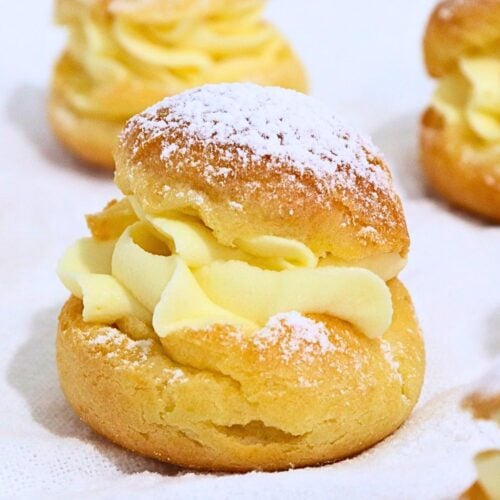
Cream Puffs Recipe (Bakery-Style!)
Print Pin VideoThis cream puffs recipe makes light, crisp pastry shells, filled with a rich, fluffy cream filling. They're surprisingly simple to make, look beautifully impressive, and taste just like they came from a bakery!
IMPORTANT: For accuracy, I would recommend using the gram measurements provided, as those are the exact quantities I use. Cup measurements are given as estimates (based on US cup measurements) to make it easier for those who do not have a scale.
Ingredients
Cream Puff Shells (Choux Pastry)
- ¾ cup (180 g) water
- ¼ cup (60 g) whole milk
- ½ cup (113 g) unsalted butter
- 1 tbsp (13 g) white granulated sugar
- ½ tsp salt - omit if using salted butter
- 1 cup (120 g) all-purpose flour
- ½ tsp vanilla essence/extract
- 4 large eggs - room temperature
- powdered sugar - for dusting before baking
Stabilized Whipped Cream Filling
- 1 cup (225 g) mascarpone - cold
- ½ cup (55 g) powdered sugar - also known as icing/confectioners' sugar
- 1 tsp vanilla essence/extract
- 1½ cups (335 g) heavy cream - cold
Instructions
Cream Puff Shells (Choux Pastry)
- Preheat the oven to 375℉ (190℃) conventional (see note 1 if using a convection oven). Line 2 baking trays with parchment paper and set aside.
- In a medium saucepan, combine the water, milk, butter, sugar, and salt. Place over medium heat, stirring occasionally until the butter has fully melted and the mixture just comes to a boil.
- Remove the saucepan from the heat and immediately add the flour all at once. Using a spatula, stir vigorously until a smooth dough forms and no dry flour remains.
- Return the saucepan to low-medium heat and cook, stirring constantly (but gently), for 1–2 minutes, or until the dough forms a ball, pulls away from the sides of the pan, and leaves a thin film on the bottom of the saucepan. Avoid overcooking the dough, as this can cause the butter to separate.
- Transfer the dough to a large mixing bowl and add the vanilla. Using a hand mixer or stand mixer fitted with the paddle attachment, mix on a low speed for about 1 minute to cool the dough slightly. The dough should feel warm, but not hot. If necessary, allow it to cool for a few more minutes before adding the eggs.
- In a separate bowl, whisk the eggs until well combined. With the mixer on a low speed, add about one-quarter of the egg mixture to the dough and mix until fully incorporated. Add another quarter and mix again. Continue adding the remaining egg mixture a little at a time, mixing well after each addition and checking the consistency as you go. Depending on factors such as humidity and how much the dough was cooked, you may not need all of the egg mixture. The dough is ready when it is smooth and glossy and slowly falls from a spatula in a thick V-shaped ribbon. It should hold its shape while still having a little movement.
- Transfer the dough to a piping bag fitted with a large round piping tip (I used a 1A tip). Pipe 2-inch (5 cm) rounds onto the prepared baking trays, leaving enough space between each one for them to expand. Shape them slightly taller rather than wider to encourage a nice rise.
- Dip your finger into a little water and gently smooth down any peaks on top of the dough. Lightly dust the tops with powdered sugar.
- Bake one tray at a time on the lower third rack of the oven for 30–35 minutes, or until the cream puffs are deep golden brown, feel light in weight, and sound hollow when tapped.
- Turn the oven off, crack the oven door open slightly, and leave the cream puffs inside for 10 minutes. Transfer them to a wire rack to cool completely. Turn the oven back on, wait until it is preheated and repeat the baking process with the remaining tray.
Stabilized Whipped Cream Filling
- To prepare the filling, combine the mascarpone, powdered sugar, and vanilla extract in a large bowl. Using a hand mixer or stand mixer, mix on a low speed for about 10 seconds, then increase to medium-high speed and mix until smooth.
- Add the cold whipping cream and mix on a low speed for about 10 seconds. Increase to medium-high speed and whip until stiff peaks form. Be careful not to overwhip the cream.
- Transfer the filling to a piping bag fitted with a 1M star piping tip.
Assembly
- To fill the cream puffs, you can use either of the following methods:Method 1: Fill from the bottom. Insert the piping tip into the bottom of each cream puff and pipe in the filling until it feels full. Finish with a light dusting of powdered sugar.Method 2: Open-style cream puffs. Using a serrated knife, carefully slice the tops off each cream puff. Pipe the filling onto the bottom half in a swirling motion, making it slightly taller than the pastry shell. Gently place the tops back on and finish with a light dusting of powdered sugar.Cream puffs are best enjoyed as soon as possible. For the best texture, I recommend filling and serving them on the same day the pastry shells are made. Enjoy!
Video
Notes
Note 1. If using a convection (fan-forced) oven, bake at 340°F (170°C), as the fan function cooks faster.
For all my tips and tricks to get the perfect cream puffs, check out the blog post :)
Nutrition
Calories: 124kcal | Carbohydrates: 6g | Protein: 2g | Fat: 10g | Saturated Fat: 6g | Polyunsaturated Fat: 0.4g | Monounsaturated Fat: 2g | Trans Fat: 0.1g | Cholesterol: 48mg | Sodium: 50mg | Potassium: 26mg | Fiber: 0.1g | Sugar: 3g | Vitamin A: 373IU | Vitamin C: 0.1mg | Calcium: 24mg | Iron: 0.3mg
Nutritional information are estimates only as they are automatically calculated by a third party application. Actual values may differ based on brands and types of products used.
Tried this recipe?I love hearing from you! Tag me @cakesbymk.nz on instagram so I can see your amazing creations :)